
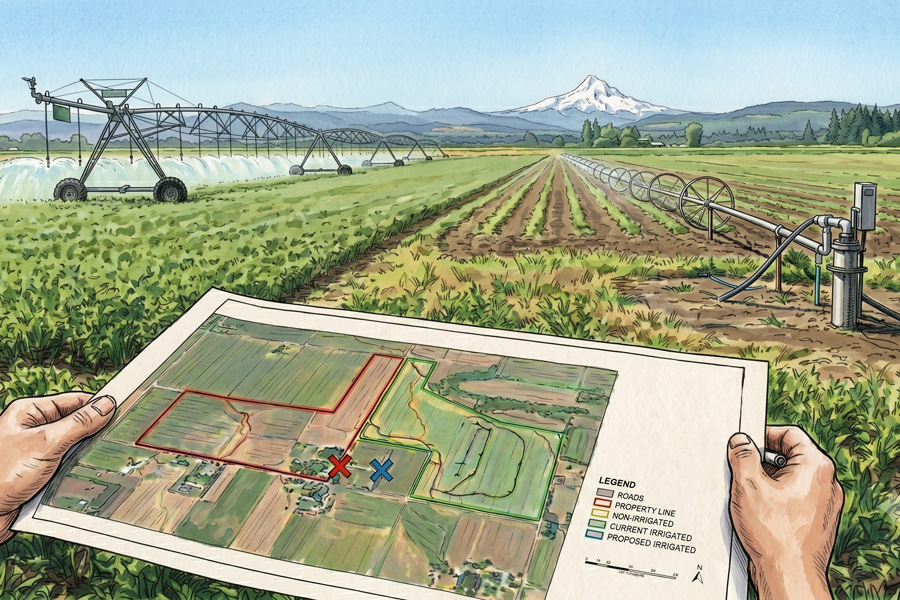
In Oregon, a water right is legally tied to a specific piece of land, a specific source, and a specific use. But businesses evolve. A farmer might install a more efficient pivot irrigation system that reshapes the active field. A real estate developer might buy a farm and need to change the water’s use from agricultural to quasi-municipal. Or a well might fail, requiring a new point of diversion.
When your operations outgrow the exact parameters listed on your water right certificate, you cannot simply move the water yourself. Doing so without state approval can result in heavy fines and put your entire water asset at risk of forfeiture. To make a change, you must navigate the Oregon Water Resources Department (OWRD) transfer process.
The Three Types of Water Right Modifications
Under Oregon law, a water right transfer allows you to modify one or more of the core components of your existing certificate:
- Point of Diversion (POD) or Appropriation: Moving the physical location where water is taken from a river, stream (diversion), or well (appropriation).
- Place of Use (POU): Shifting the legal description of the land where the water is beneficially applied.
- Character of Use: Changing the type of activity the water supports (e.g., converting an irrigation right into an industrial or commercial right).
Permanent vs. Temporary Transfers
Depending on your operational timeline, OWRD allows for two distinct pathways:
Permanent Transfers
A permanent transfer permanently rewrites your water right certificate. To gain approval, OWRD must determine that the modification will neither injure other existing water rights nor enlarge the original right (i.e., you cannot use more water or irrigate more acres than originally permitted).
Under OWRD’s standardized modernization rules, the permanent transfer process flows through two critical legal steps: the Initial Review (formerly known as a Draft Preliminary Determination) and the Proposed Final Order (PFO).
Critical Deadline Note: Once OWRD issues its Initial Review, applicants have a strict 30-day window to submit a written request to continue processing the application along with any missing data. Missing this window means the application file is automatically closed. However, if no public protests are filed against the subsequent PFO, it will automatically convert into a binding Final Order exactly 33 days after the close of the protest period, eliminating historical multi-month agency backlogs.
Temporary Transfers
If you need immediate operational flexibility, a temporary transfer can be granted for up to five years. This is commonly used by irrigation districts or individual landowners to adjust to short-term changes or to keep operations running smoothly while a permanent transfer application undergoes OWRD review.
Why Professional Mapping and a CWRE Are Required
The single biggest point of failure for water right transfers is inaccurate documentation. OWRD requires highly detailed, legally precise maps to prove that the “from” lands (where the water is currently used) match the historical certificate and that the “to” lands (the new location) are accurately delineated.
In almost all cases, permanent transfers require a map prepared by a Certified Water Right Examiner (CWRE) or a licensed professional surveyor.
If a submitted map is inaccurate, it can result in:
- Multi-month delays or outright denial by OWRD.
- Accidental forfeiture of portions of your water right (under Oregon law, any part of a water right involved in a transfer that is not successfully changed or maintained can be lost).
- Legal protests from neighboring water users claiming “injury” to their senior water rights.
Taking the Next Step
Before filing a transfer application with OWRD, it is vital to conduct a preliminary assessment to ensure your water right is healthy, active, and legally eligible for a transfer.